Calcutta High Court Typing Test
Calcutta High Court
Typing Test 2026
Practice the exact pattern of the Calcutta High Court typing skill test — authentic legal passages in English and Bengali, strict backspace-disabled mode, and the official speed standards for Typist, Copyist, PA, and Stenographer posts. Completely free, unlimited sessions.
⚖️ Start Practice NowCalcutta High Court Typing Test — Complete Guide 2026
The Calcutta High Court — one of India's three original High Courts, established in 1862 under the Indian High Courts Act — holds jurisdiction over West Bengal and the Union Territory of Andaman & Nicobar Islands. It is among the most prestigious judicial institutions in the country and recruits Copyists, Typists, Stenographers, and Personal Assistants through a selection process that includes a mandatory Typing Skill Test.
The Calcutta HC typing test is unique in requiring proficiency in both English (up to 40 WPM) and Bengali (30 WPM) — making it one of the few High Courts in India to test a regional script language alongside English. Bengali is the official language of West Bengal and is used extensively in district court correspondence, regional orders, and state government communications that court clerks handle daily.
Bengali typing in this exam uses the Inscript Unicode keyboard layout — the same standardised government layout used for Hindi, Marathi, Telugu, and other Indian languages on modern exam software. The structure shares similarities with the Devanagari Inscript layout, giving Hindi typists a small head start. However, Bengali has its own unique characters — ব, ভ, ড়, ঢ়, ক্ষ and various conjuncts — that require dedicated separate practice. Using a phonetic input method during preparation will not transfer to the exam's Inscript-based system.
Both language tests are conducted with backspace completely disabled. Every character typed is permanent — errors reduce your net score directly and cannot be undone. Legal passages here come from actual Calcutta HC orders, contempt notices, writ petition records, and Bengal-specific judicial documents. Candidates who only practice on general-topic typing websites are consistently unprepared for the formal legal vocabulary and sentence complexity on exam day.
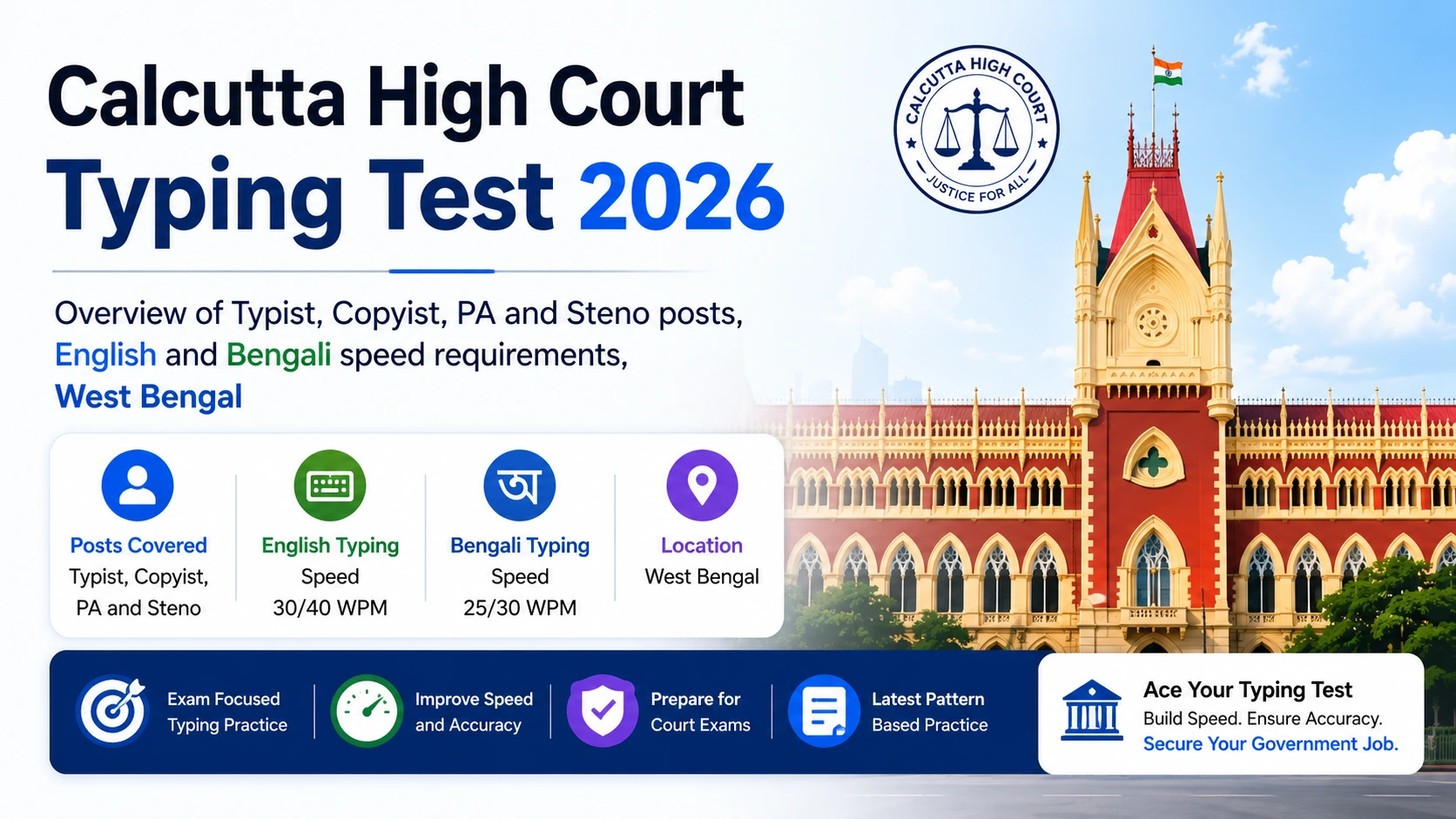
Post-wise Typing Speed Requirements — Calcutta High Court 2026
Speed thresholds differ by post. Always verify with the official Calcutta HC recruitment notification for your specific vacancy cycle.
| Post Name | English Speed | Bengali Speed | Duration | Backspace | Test Nature |
|---|---|---|---|---|---|
| Copyist / Typist | 35 WPM Net | 30 WPM Net | 10 Minutes | Disabled | Qualifying |
| Personal Assistant (PA) | 40 WPM Net | 30 WPM Net | 10 Minutes | Disabled | Qualifying |
| Stenographer Grade III | 80 WPM Shorthand | — | 5 Min Dictation | Disabled | Qualifying |
| Senior Stenographer / Private Secretary | 100 WPM Shorthand | — | 5 Min Dictation | Disabled | Qualifying |
What Makes Calcutta HC Typing Test Different?
Four key factors that every candidate should understand before starting their preparation.
- Layout: Inscript Unicode — same logic as Hindi Inscript
- Bijoy (legacy font) may appear in older notifications — confirm before practicing
- Unique characters: ব, ভ, ড়, ঢ়, ক্ষ, and conjunct consonants (yuktakshar)
- Formal "Shuddha Bangla" used in court passages — differs from conversational Bengali
- Hindi Inscript knowledge gives a 30–40% head start — still needs dedicated Bengali practice
- Phonetic input methods will not work in the actual exam software
- English: "petitioner," "respondent," "contempt," "habeas corpus," "stay order"
- Bengali: formal judicial Bengali used in Calcutta HC and district court orders
- Passage structure: long formal sentences, procedural terminology, case references
- Bengal-specific: land acquisition notices, Panchayat court orders in Bengali
- Candidates unfamiliar with legal vocabulary slow down mid-passage — causing errors
- Platform passages are sourced from real legal court contexts for both languages
- Established 1862 — one of India's three original High Courts
- Jurisdiction: West Bengal + Andaman & Nicobar Islands
- Circuit Bench at Port Blair (Andaman), Circuit Bench at Jalpaiguri
- One of the highest-prestige judicial postings in Eastern India
- Clerical and steno posts attract thousands of applicants per cycle
- Direct recruitment conducted by Calcutta HC's own notification system
- Practicing Bengali with phonetic input instead of Inscript layout
- Using backspace during practice — builds the wrong reflex entirely
- Skipping Bengali sessions after English feels comfortable
- Not reading legal content — vocabulary shock slows typing mid-test
- Targeting exactly 40/30 WPM — no buffer for exam-day pressure drop
- Ignoring font confirmation — wrong layout wastes weeks of preparation
8 Expert Tips to Clear Calcutta HC Typing Test on First Attempt
Practical, honest advice for both English and Bengali — built around exactly what the Calcutta High Court exam demands.
The single most impactful change you can make. Every session where you allow backspace builds the reflex to reach for it after errors — a reflex that the actual exam makes completely useless. Backspace disabled isn't just an exam rule; it's a training discipline. When you're forced to keep typing forward after a mistake, you develop two things: a lower error rate (because you become more careful) and better psychological composure (because you stop spiralling after small mistakes).
The Calcutta HC exam software uses Inscript Unicode. If you're practicing with a phonetic layout (where typing "ka" gives you ক), that input method simply will not function in the exam. Everything you've practiced will be unusable. Similarly, if an older notification specified Bijoy font, confirm whether the current cycle still uses it — Bijoy is a legacy non-Unicode font with a completely different key mapping from Inscript. Getting this wrong can waste 4–6 weeks of preparation. Check your notification, then practice exclusively in that layout.
Legal vocabulary is the hidden speed-killer. Words like "interlocutory," "suo motu," "writ of mandamus," and "contempt of court" appear in English passages regularly. Bengali passages use formal Shuddha Bangla legal constructs that look nothing like everyday written Bengali. Reading one short court order excerpt each day — in both English and Bengali — will steadily build the vocabulary familiarity that stops you from hesitating mid-test. You won't type faster by reading, but you will stop slowing down for unfamiliar words, which is almost the same improvement.
The official cutoffs are 40 WPM English and 30 WPM Bengali. Exam-day conditions — an unfamiliar keyboard in a government building, the noise of other candidates, the psychological weight of knowing it's the real test — will typically drop your speed by 4–6 WPM compared to relaxed home practice. If you're consistently hitting 44 WPM English and 34 WPM Bengali with 96%+ accuracy in your practice sessions, you will pass comfortably. If you're barely hitting 40 and 30, you are preparing to fail under pressure.
Net WPM = (Total Words Typed − Error Words × 2) ÷ Minutes. Every error word costs you 2 WPM from your gross. At 40 WPM over 10 minutes you type roughly 400 words. With 8 errors (which feels like very few), your net drops to (400 − 16) ÷ 10 = 38.4 WPM — below the 40 WPM cutoff. Since backspace is off, those errors cannot be fixed. This formula means slowing down by 2 WPM and reducing errors from 8 to 2 will raise your net score by more than 1 WPM — accuracy genuinely outperforms raw speed in this exam.
The most common preparation mistake: candidates focus heavily on their weaker language, then stop practicing their stronger one — and discover on exam day that both have regressed. Two 10-minute sessions daily (one English, one Bengali) produce far better results than marathon sessions of one language once or twice a week. The contrast between switching keyboard layouts also reinforces accuracy in both languages — you become more deliberate with each key because one wrong press sends the wrong script character entirely.
Hunt-and-peck typists almost never sustain 40 WPM with high accuracy over 10 minutes. For English, learn and hold the standard home-row position: ASDF for left hand, JKL; for right. For Bengali Inscript, memorise which finger group controls which key zone from a printed keyboard chart — and keep that chart at your desk for only the first two weeks, after which it should be face-down. Touch typing doesn't just increase speed; it decreases mental load during typing, which means more attention available for accuracy.
On the morning of the real Calcutta HC typing test, avoid a full practice session — it tires your fingers and heightens anxiety without producing useful warm-up. Instead: do a gentle 2-minute slow-speed warmup on both languages to activate muscle memory, eat a normal breakfast, arrive at the centre early. At the terminal, read the passage for the full preview time (if offered) before the timer begins — familiarity with the first few lines eliminates the cold-start slowdown that costs many candidates their first 30 seconds.
Calcutta HC vs Other East & North Indian High Courts — Typing Comparison
See how the Calcutta HC typing test compares to Patna, Allahabad, Delhi, and other major High Courts.
| High Court | English Speed | Regional Language | Regional Speed | Backspace | Est. |
|---|---|---|---|---|---|
| Calcutta HC | 35–40 WPM | Bengali (Inscript) | 30 WPM | Disabled | 1862 |
| Patna HC | 30–35 WPM | Hindi (Inscript) | 25–30 WPM | Disabled | 1916 |
| Allahabad HC | 35–40 WPM | Hindi (Mangal/KD) | 25–30 WPM | Disabled | 1866 |
| Delhi HC | 35–40 WPM | Hindi (Mangal) | 30 WPM | Disabled | 1966 |
| Bombay HC | 35–40 WPM | Marathi (Inscript) | 30 WPM | Disabled | 1862 |
| Gauhati HC | 30–35 WPM | Assamese (Inscript) | 25–30 WPM | Disabled | 1948 |
Calcutta High Court Typing Test — Frequently Asked Questions
Honest, detailed answers to every question West Bengal HC aspirants commonly ask before starting preparation.
What is the typing speed required for Calcutta High Court Typist post?
Which keyboard layout is used for Bengali typing in Calcutta High Court?
How is Bengali Inscript different from Hindi Inscript?
How long does it take to reach 40 WPM English and 30 WPM Bengali?
- English at 32–36 WPM: 4–5 weeks to reach 40+ WPM with daily practice
- English at 22–28 WPM: 7–9 weeks of consistent sessions
- Bengali — knows Hindi Inscript: 4–6 weeks to reach 30+ WPM Bengali
- Bengali — complete Inscript beginner: 9–12 weeks
- Bengali — knows Bijoy (legacy): 5–7 weeks to switch to Inscript
Is Bengali typing mandatory for all Calcutta HC posts?
What is Bijoy font and is it still used in Calcutta HC exams?
What kind of passages are given in the Calcutta HC typing test?
Can I practice Bengali typing for Calcutta HC on this platform?
How is the Calcutta HC typing test different from Patna or Allahabad HC?
Start Your Calcutta HC Typing Preparation
Bengali & English legal passages · Backspace disabled · Exam-exact pattern · 100% free — practice right now.