Andhra Pradesh High Court Typing Test
Andhra Pradesh High Court
Typing Test 2026
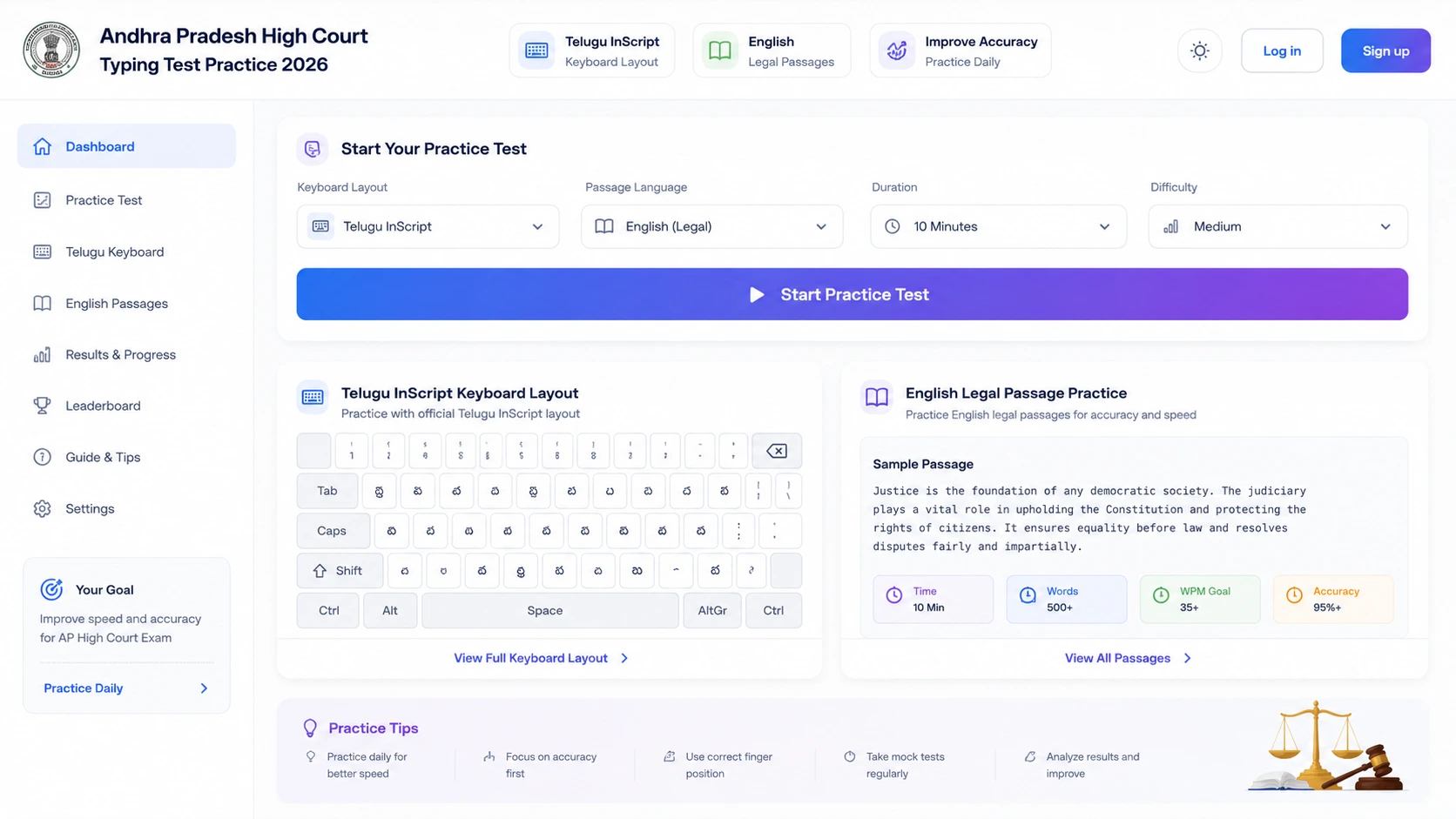
Prepare for the Andhra Pradesh High Court typing skill test with authentic legal passages in both English and Telugu. Backspace disabled, 10-minute timer, real court vocabulary — the closest exam-pattern practice available online, completely free.
⚖️ Start Practice NowAndhra Pradesh High Court Typing Test — Complete Guide 2026
The Andhra Pradesh High Court, headquartered at Amaravati, is the principal judicial authority for the state of Andhra Pradesh. Established following the bifurcation of the combined Andhra Pradesh state in 2014, it recruits clerical and stenographic staff regularly through a selection process that includes a mandatory typing skill test for Typist, Junior Assistant, Personal Assistant, and Stenographer posts.
What makes the AP High Court typing test distinctive is its dual language requirement. Candidates must demonstrate typing proficiency in both English (35 WPM minimum) and Telugu (30 WPM minimum). Telugu is the official language of the state and is used extensively in court communications, regional orders, and district-level judicial documents. Being fluent in Telugu legal vocabulary is not optional — it is a direct professional necessity for court staff in Andhra Pradesh.
Both language tests are conducted with backspace completely disabled. This means every character you type is permanent — errors reduce your net score directly and cannot be corrected. Telugu typing uses the InScript keyboard layout, a standardised layout used across all Indian language typing tests for government recruitment. If you have previously practiced Hindi InScript, the base layout will feel partially familiar, but Telugu has unique characters and conjuncts that require dedicated separate practice.
Legal passages in this exam come from actual AP High Court orders, writ petition records, and judicial correspondence — both in English and Telugu. Candidates who practice with banking or general topic passages are consistently disadvantaged by the specialist vocabulary on exam day. Our platform uses authentic legal-context passages for both languages so your preparation reflects the real exam experience as closely as possible.
Post-wise Typing Speed Requirements — AP High Court 2026
Speed targets differ by post. Practice for the exact role you are targeting in the recruitment notification.
| Post Name | English Speed | Telugu Speed | Duration | Backspace | Test Nature |
|---|---|---|---|---|---|
| Typist / Junior Assistant | 35 WPM Net | 30 WPM Net | 10 Minutes | Disabled | Qualifying |
| Personal Assistant (PA) | 40 WPM Net | 30 WPM Net | 10 Minutes | Disabled | Qualifying |
| Stenographer Grade III | 80 WPM Shorthand | — | 5 Min Dictation | Disabled | Qualifying |
| Senior Steno / Private Secretary | 100 WPM Shorthand | — | 5 Min Dictation | Disabled | Qualifying |
What You Need to Know Before Preparing
Key facts about the AP High Court typing test that every candidate should understand before day one of preparation.
- Standard layout: InScript (Inscript) keyboard — Unicode output
- Same base layout as Hindi InScript but with Telugu-specific characters
- Unique Telugu characters: ళ, ఱ, ఔ, conjunct consonants (ottulu)
- Formal "Shuddha Telugu" used in court passages — differs from spoken Telugu
- Must practice on a Telugu keyboard overlay or printed layout chart
- Confirmation of font/layout required from official notification
- English passages: "petitioner," "respondent," "writ of mandamus," "stay order"
- Telugu passages: formal judicial Telugu used in district court orders
- Passages drawn from AP HC judgment excerpts and official notices
- Sentence structures are long and complex — very different from banking text
- Unfamiliar vocabulary mid-test causes hesitation and errors
- Practice with legal passages (available on this platform) is essential
- Every error stays on screen and counts against your Net WPM
- Practicing with backspace on builds the wrong muscle memory
- Accuracy-first mindset must be developed in practice — not just exam day
- One careless section of fast typing can drop Net WPM below the cutoff
- Target 38+ WPM English in practice to pass 35 WPM comfortably under pressure
- Established in 2019 at Amaravati after the 2014 bifurcation
- Jurisdiction over all of Andhra Pradesh (26 districts)
- Benches at Amaravati (Principal), with circuit sittings at other cities
- Conducts direct recruitment for clerical cadre through its own notifications
- High competition — each vacancy cycle attracts thousands of applications
7 Expert Tips to Clear AP High Court Typing Test
Specific strategies for English and Telugu — built around the exact demands of the Andhra Pradesh High Court exam.
This is the most critical and most commonly ignored rule. If you allow backspace during practice, your fingers develop a reflex to reach for it after every error. In the actual AP HC exam, that reflex costs you rhythm and focus every time it fires — because backspace does nothing. Force yourself to type forward from the very first practice session. It feels uncomfortable for the first week and transformative by the third.
If you already know Hindi InScript, you have a small advantage — the base key positions share the same vowel and consonant mapping logic. But Telugu has unique characters (ళ, ఱ, and various conjunct forms called "ottulu") that don't exist in Hindi. More importantly, formal court Telugu uses grammatical constructions that differ sharply from casual written Telugu. Treat this as a new language skill. Print an InScript Telugu keyboard chart, keep it beside you for the first two weeks, and never look at the keyboard during timed sessions.
Legal vocabulary is the silent speed-killer in this exam. When you encounter "interlocutory application" or "suo motu cognizance" for the first time mid-test, your eyes pause, your rhythm breaks, and your fingers hesitate. Reading one short judgment excerpt in English and one AP district court order in Telugu each day during your preparation period will make this vocabulary feel natural. You won't type faster overnight, but you'll stop slowing down for unfamiliar words — which is almost the same thing.
The official cutoffs are 35 WPM English and 30 WPM Telugu. But exam-day conditions — an unfamiliar keyboard, a new typing chair, noise, other candidates, and the pressure of the real thing — will cost you 3–5 WPM compared to your practice speed. If you're barely hitting the cutoff in relaxed practice, you will not pass on exam day. Set your daily practice targets 3–5 WPM above the official minimums. When you consistently hit 38 and 33 with clean accuracy, you are genuinely ready.
A common preparation mistake: candidates spend all their time on their weaker language and stop practicing the stronger one — only to find it has regressed by exam day. One 10-minute English session in the morning and one 10-minute Telugu session in the evening is far more effective than a single 20-minute block of one language. The contrast between the two keyboard layouts actually reinforces accuracy in both — you become more deliberate with each key because you know the wrong one sends the wrong character.
Net WPM = (Total Words Typed − Error Words × 2) ÷ Minutes. At 35 WPM over 10 minutes, you type roughly 350 words. With 6 error words, your net drops to (350 − 12) ÷ 10 = 33.8 WPM — below the cutoff. Since backspace is off, those 6 errors cannot be fixed. This is why accuracy matters more than raw speed. Slowing down by 2 WPM and cutting errors from 6 to 2 will raise your net score by nearly 3 WPM. Do the math in your own practice sessions and adjust your approach accordingly.
Two-finger typists almost never reach 35 WPM with high accuracy consistently across a 10-minute session. For English, learn and use the standard home-row ASDF-JKL; position. For Telugu InScript, memorise which finger controls which key group and never deviate. The initial slowdown when switching to proper touch typing technique is temporary — usually 2–3 weeks. After that, both your speed and accuracy will surpass whatever you achieved with informal technique, and will keep improving naturally.
AP High Court vs Other South Indian High Courts — Typing Test Comparison
How the Andhra Pradesh HC typing test compares to Telangana, Madras, and Kerala High Courts.
| High Court | English Speed | Regional Language | Regional Speed | Backspace |
|---|---|---|---|---|
| Andhra Pradesh HC | 35–40 WPM | Telugu (InScript) | 30 WPM | Disabled |
| Telangana HC | 35–40 WPM | Telugu (InScript) | 30 WPM | Disabled |
| Madras HC (Tamil Nadu) | 40 WPM | Tamil (InScript) | 30 WPM | Disabled |
| Kerala HC | 35 WPM | Malayalam (InScript) | 30 WPM | Disabled |
| Karnataka HC | 35 WPM | Kannada (InScript) | 30 WPM | Disabled |
| Bombay HC | 40 WPM | Marathi (InScript) | 30 WPM | Disabled |
Andhra Pradesh High Court Typing Test — Frequently Asked Questions
Honest, detailed answers to every question candidates commonly ask before starting AP HC typing preparation.
What is the typing speed required for AP High Court Typist post?
Which keyboard layout is used for Telugu typing in AP High Court?
How is Net WPM calculated in the AP High Court typing test?
Is Telugu typing mandatory for all AP High Court posts?
How is Telugu InScript different from Hindi InScript?
Can I practice Telugu typing for AP HC on this platform?
How long does it take to reach 35 WPM English and 30 WPM Telugu?
- English already at 28–32 WPM: 3–4 weeks to reach 35+ WPM
- English at 20–25 WPM: 6–8 weeks of consistent daily sessions
- Telugu — knows Hindi InScript: 4–5 weeks to reach 30 WPM Telugu
- Telugu — complete beginner to InScript: 8–12 weeks
What kind of passages are given in the AP HC typing test?
Is the AP High Court typing test the same as the Telangana High Court typing test?
Start Your AP High Court Typing Preparation
Telugu & English legal passages · Backspace disabled · Exam-exact pattern · 100% free.